
Losing a tooth, or several teeth, is more common than most people realize. According to the American College of Prosthodontists, more than 36 million Americans are missing all of their teeth, and nearly 120 million are missing at least one. If you’re among them, you’ve likely come across two main options: dental implants (permanent tooth replacements anchored to your jawbone) and dentures (removable tooth replacements). Both can restore your smile and your ability to eat and speak comfortably. But they work very differently, and the right choice depends on your specific situation.
This post breaks down what each option involves, how they compare across the factors that matter most to patients, and what to consider when making your decision.
How Dental Implants Work
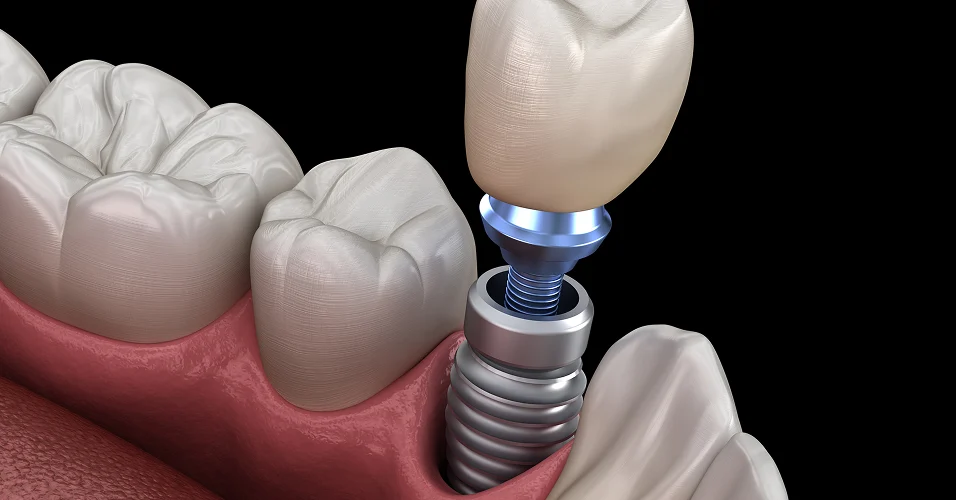
A dental implant is a small titanium post placed into your jawbone during a minor surgical procedure. Over the following months, the post goes through osseointegration (the process where the titanium fuses naturally with your jawbone), creating a stable, permanent anchor. Once healed, a custom crown is attached to the post, giving you a replacement tooth that looks, feels, and functions like a natural one.
Implants are used to replace single teeth, multiple teeth, or entire arches. Procedures like All-on-4 and All-on-6 use a small number of implant posts to support a full set of fixed replacement teeth, offering an alternative to traditional full dentures.
How Dentures Work
Dentures are removable appliances custom-fitted to your gums. Full dentures replace an entire arch of missing teeth. Partial dentures fill gaps when some natural teeth remain, using clasps or attachments to stay in place. Traditional dentures rest on the gumline and rely on suction, adhesive, or attachment to existing teeth for stability.
Implant-supported dentures offer a middle ground. They use dental implants as anchors to hold a denture firmly in place, which addresses some of the comfort and stability issues associated with traditional dentures while remaining a more affordable alternative to fully fixed implant restorations.
Side-by-Side Comparison
Here’s how the two options stack up across the factors patients ask about most:
| Factor | Dental Implants | Traditional Dentures |
| Looks and feels natural | ✓ Yes | Varies |
| Permanent (no removal) | ✓ Yes | ✗ No |
| Preserves jawbone | ✓ Yes | ✗ No |
| Eating comfort | Full function | Limited |
| Maintenance | Brush & floss | Daily removal |
| Lifespan | Decades+ | 5–10 years |
| Upfront cost | Higher | Lower |
| Bone loss prevention | ✓ Yes | ✗ No |
The Jawbone Factor: Why It Matters Long-Term
One of the most significant differences between implants and dentures is what happens to your jawbone over time. When a natural tooth is lost, the jawbone beneath it no longer receives stimulation from chewing. Without that stimulation, the bone gradually resorbs, meaning it shrinks. This is a natural biological process, and it happens whether or not you wear a denture.
Traditional dentures rest on the gumline and don’t interact with the jawbone at all, so bone loss continues underneath them. Over time, this changes the shape of your jaw, which is why dentures often need to be refitted or replaced as the years pass.
Dental implants are the only tooth replacement option that addresses bone loss directly. Because the titanium post is embedded in the jawbone, it mimics the stimulation of a natural tooth root. The bone is preserved, your facial structure stays intact, and your restoration continues to fit correctly for decades.
Understanding the Cost Difference
Dentures have a lower upfront cost, and that’s a real consideration for many patients. But the long-term picture is more nuanced. Traditional dentures typically need to be replaced every five to ten years as the jawbone changes shape. They may also require adhesives, professional adjustments, and occasional repairs. When you add those costs over a lifetime, the gap between dentures and implants narrows considerably.
Dental implants, with proper care, can last decades. Many patients consider them a long-term investment that pays off in durability, comfort, and function over time. At Berkshire Smile Studio, we work with several financing partners including CareCredit, Cherry, Proceed Finance, and Lending Club to help make implant treatment accessible. Many patients are surprised by how manageable the monthly payments can be.
Are You a Candidate for Dental Implants?
Most adults in good general health are candidates for dental implants. Factors we evaluate include:
- Sufficient jawbone density to support the implant post (bone grafting can address this if needed)
- Healthy gums without active periodontal (gum) disease
- No uncontrolled systemic conditions that affect healing
- Non-smoker or willingness to stop smoking during the healing phase
We use CBCT imaging (a detailed three-dimensional X-ray) to assess your jawbone and anatomy precisely before recommending any treatment. This helps us give you an accurate picture of your options rather than a one-size-fits-all answer.
Which Option Is Right for You?
There’s no single correct answer. Some patients are excellent implant candidates and strongly prefer a permanent, fixed solution. Others have medical factors or budget considerations that make dentures the more practical choice right now. Some patients start with dentures and transition to implant-supported options later.
What matters is that your decision is based on complete, accurate information rather than assumptions. The best way to understand your specific options is with a thorough consultation that takes your health history, bone structure, and goals into account.
At Berkshire Smile Studio, Dr. Shakil Syed brings over 12 years of experience and specialized implant training, including completion of the prestigious Maxicourse in Implantology, to every consultation. We serve patients throughout Pittsfield, MA and the Berkshire region, and we take the time to walk through your options clearly so you can make a confident, informed decision.