


Losing a tooth can affect more than just your smile. It changes how you eat, speak, and feel about yourself. When you need to replace missing teeth, you have several choices to consider, such as dental implants vs dentures.
One of the biggest benefits of dental implants is that they are the closest thing to natural teeth and offer the most permanent solution for tooth replacement available today.
Unlike dentures or bridges, dental implants can last a lifetime with proper care and help prevent bone loss in your jaw. They look natural, feel comfortable, and work just like your original teeth.
If you’re dealing with missing teeth, understanding why dental implants stand out from other options can help you make the right choice.
This guide explains how implants work, what makes them different, and whether they might be right for you.
Key Takeaways
- Dental implants replace your missing tooth root with a permanent post that fuses to your jawbone and supports an artificial tooth
- Implants preserve your jawbone and facial structure while other replacement options can lead to bone loss over time
- Most people with good oral health and adequate jawbone can benefit from dental implants regardless of age
Table of Content
- Understanding Dental Implants and How They Work
- Comparing Tooth Replacement Options
- Core Benefits and Unique Advantages of Dental Implants
- Who Can Benefit From Dental Implants?
- The Dental Implant Procedure Explained
- Frequently Asked Questions
Understanding Dental Implants and How They Work
Dental implants function as artificial tooth roots that dentists surgically place into your jawbone to create a stable foundation for replacement teeth.
The success of this tooth replacement method depends on three main components working together and a natural healing process that bonds the implant to your bone.
What Are Dental Implants?
A dental implant is an artificial tooth root that a dentist surgically places into your jawbone to support a replacement tooth. Think of it as a small titanium screw that replaces the root of your missing tooth.
More than 5 million dental implants are placed in the U.S. every year. They work much like your natural teeth once they’re fully healed.
Dental implants provide support for artificial teeth like crowns, bridges, and dentures. You can replace a single tooth, multiple teeth, or even a full mouth reconstruction.
The implant itself stays hidden under your gums. What you see in your mouth is the replacement tooth that attaches to the implant.
Key Components: Implant Post, Abutment, and Artificial Tooth
Every dental implant system consists of three separate parts that work together:
The Implant Post is a small titanium screw that goes into your jawbone. This post replaces your natural tooth root and provides the foundation for everything else.
The Abutment is a connector piece that attaches to the top of the implant post. Your dentist typically adds this component after your implant heals. It sticks up through your gums and holds your artificial tooth in place.
The Artificial Tooth is the visible part you see when you smile. This can be a crown for a single tooth, a bridge for multiple teeth, or a denture for many teeth. Your dentist custom-makes this piece to match your natural teeth in color and shape.
All three components must fit together properly for your implant to function correctly.
Osseointegration: Achieving Stability in the Jawbone
Osseointegration is the process where your jawbone fuses to the dental implant. This natural healing process is what makes dental implants so stable and long-lasting.
After your dentist places the implant post into your jawbone, your body begins to grow new bone tissue around it. The bone gradually attaches to the titanium surface of the implant.
This process takes anywhere from three to nine months. The timeline depends on how quickly your body heals and where the implant is located in your mouth.
You must wait for osseointegration to complete before your dentist can attach your final tooth. Rushing this step can cause the implant to fail.
Once osseointegration is complete, your implant becomes as strong as a natural tooth root. It can handle the same chewing forces without moving or shifting.
Restore your smile with dental implants designed for long-term comfort, function, and confidence.
Comparing Tooth Replacement Options
Dental implants stand out when placed side-by-side with other tooth replacement options, offering better stability, bone preservation, and long-term value.
Understanding how implants compare to dentures and bridges helps you make the right choice for your smile.
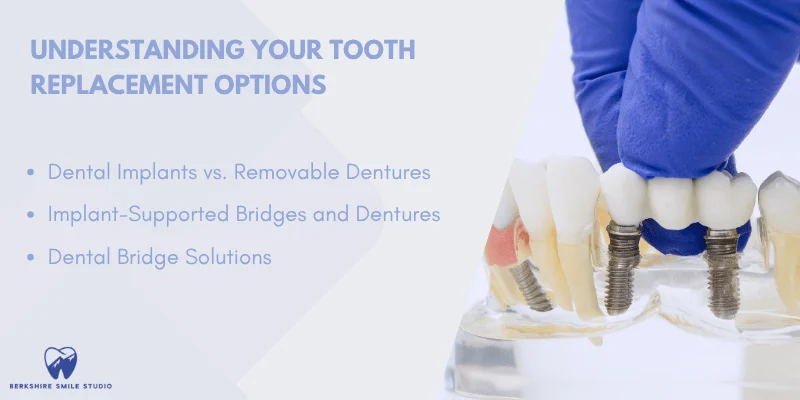
Dental Implants vs. Removable Dentures
Removable dentures sit on top of your gums and rely on suction or adhesive to stay in place. They cost between $800 to $1,500 for a full set, making them much more affordable than dental implants.
However, dentures don’t prevent bone loss in your jaw. Without tooth roots to stimulate the bone, your jawbone gradually shrinks over time. This causes your dentures to become loose and uncomfortable.
You’ll need to replace your dentures every five years as they wear down. They can slip while eating or talking, and food often gets trapped between the dentures and your gums.
Dental implants replace both the tooth root and crown. They fuse with your jawbone and can last a lifetime with proper care.
While a single implant costs $1,500 to $6,000, you won’t face the ongoing replacement costs that come with dentures.
Implant-Supported Bridges and Dentures
Implant-supported dentures and bridges combine the affordability of traditional dentures with the stability of dental implants.
These options use four to six implants per jaw to secure your replacement teeth, rather than requiring an implant for each missing tooth.
All-on-4 implant-supported dentures cost around $15,000 per arch. They’re permanently fixed in place, so you don’t remove them at night like traditional dentures. This gives you much better chewing ability and confidence.
Implant-supported bridges work well when you’re missing several teeth in a row. Two implants anchor a bridge of replacement teeth between them.
This costs less than individual implants for each tooth while still providing the bone-preserving benefits of implant placement.
Both options stop bone loss and feel more natural than removable dentures. You can eat all your favorite foods without worrying about your teeth shifting.
Dental Bridge Solutions
A dental bridge attaches artificial teeth to crowns placed on your natural teeth on either side of the gap. Bridges cost less than implants initially and don’t require surgery.
Your dentist must grind down healthy teeth to place the crowns that support the bridge. This permanently alters those teeth and can weaken them over time. Bridges last about 10 years before needing replacement.
Like dentures, bridges don’t replace tooth roots. The bone under your missing tooth continues to deteriorate, which can eventually affect the fit and appearance of your bridge.
This bone loss can cause your face to look sunken as the years pass.
Cleaning under a bridge requires special floss threaders because the replacement teeth are connected. Food and bacteria can accumulate in hard-to-reach areas, potentially leading to decay in the supporting teeth.
Core Benefits and Unique Advantages of Dental Implants
Dental implants stand out from other tooth replacement options because they replace both the visible tooth and the root beneath your gums.
This complete replacement approach delivers benefits that affect your appearance, daily comfort, and long-term oral health.
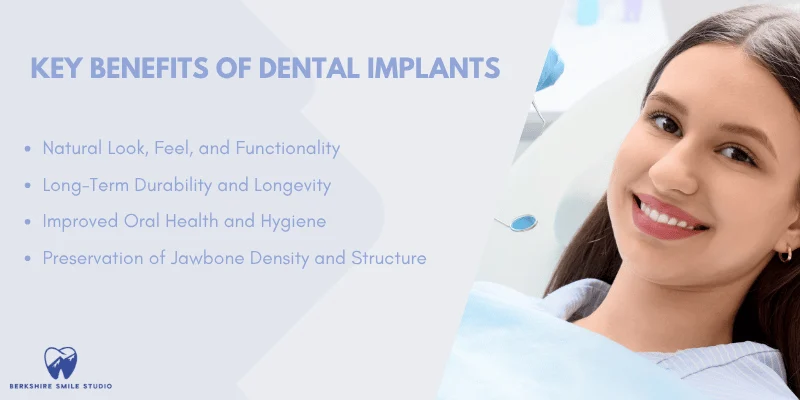
Natural Look, Feel, and Functionality
When you get dental implants, you’re choosing a replacement that mimics your natural teeth in every way. The artificial teeth attached to implants are custom-made to match the color, shape, and size of your surrounding teeth.
You can eat all your favorite foods without worry. Unlike dentures that can slip or bridges that may feel different, implants function just like natural teeth when you bite and chew. You won’t need to avoid hard or sticky foods.
Your speech stays clear and natural too. Because implants are securely anchored in your jaw, they won’t shift around when you talk.
This means you can speak confidently without the clicking sounds or slipping that sometimes happens with removable dentures.
The stability of implants also means you don’t have to worry about embarrassing moments. They stay firmly in place during meals, conversations, and daily activities.
Long-Term Durability and Longevity
Dental implants are built to last a lifetime with proper care. The titanium post that goes into your jawbone is extremely durable and resistant to decay.
With good oral hygiene and regular dental visits, your implant can last a lifetime. The crown on top may need replacement after 10 to 15 years due to normal wear, but the implant itself typically stays intact.
This longevity makes implants cost-effective over time. While the upfront cost is higher than bridges or dentures, you won’t need frequent replacements or adjustments. Other options often need replacement every 5 to 10 years.
The success rate for dental implants is very high. Most implants placed by an experienced professional work well for decades when you maintain proper care.
Improved Oral Health and Hygiene
Your oral health actually improves with dental implants. Unlike bridges, which require grinding down healthy adjacent teeth, implants don’t involve your neighboring teeth at all.
You can clean around implants just like natural teeth. Regular brushing twice daily keeps them in great shape. An interdental brush helps you clean between the implant and adjacent teeth effectively.
Flossing around implants is straightforward too. You don’t need special tools or complicated techniques as you do with bridges. This simple maintenance routine helps you maintain better oral hygiene overall.
Food particles don’t get trapped under implants the way they can with bridges or dentures. This reduces your risk of gum disease and tooth decay in surrounding teeth.
Preservation of Jawbone Density and Structure
One of the most important advantages of dental implants is how they protect your jawbone. When you lose a tooth, the bone in that area starts to break down because it no longer receives stimulation from chewing.
Implants prevent bone loss by acting as artificial tooth roots. They stimulate the bone to preserve form and density through the pressure of normal chewing and biting. This keeps your jaw strong and healthy.
Without this stimulation, your jawbone can shrink over time. This creates a sunken facial appearance that makes you look older. By choosing implants, you preserve bone and maintain your natural face shape.
Your jawbone health affects more than just appearance. Strong jawbone density provides support for your remaining natural teeth and keeps them properly aligned. Implants help maintain the structural integrity of your entire mouth.
Who Can Benefit From Dental Implants?
Dental implants work for people who have lost one tooth or many teeth. The key factors are having enough jawbone density to support the implant and being in good overall health.
Replacing a Single Missing Tooth
If you have lost just one tooth, a dental implant offers the most natural solution. The implant can replace a single tooth without affecting your other healthy teeth.
Unlike a traditional bridge, which requires grinding down the teeth on either side, an implant stands alone. A prosthodontist or dentist places a titanium post into your jawbone where the missing tooth used to be.
After the bone heals around the post, they attach a custom same-day crown that looks and functions like your natural tooth.
This option prevents your other teeth from shifting into the empty space. It also keeps your jawbone healthy by providing the stimulation it needs to maintain its strength.
Restoring Multiple or All Missing Teeth
You can use implants to restore missing teeth even if you’ve lost several or all of them. Prosthodontists can attach bridges or full dentures to implants for a secure fit.
For multiple missing teeth, dentists often place two or more implants to support a bridge. If you need to replace missing teeth on your entire upper or lower jaw, a full set of implant-supported dentures may work best.
This approach typically requires four to six implants per arch.
These solutions feel more stable than traditional dentures that rest on your gums. You won’t need to worry about your teeth slipping when you eat or speak.
Candidacy Criteria and Jawbone Assessment
Your jawbone density plays a major role in whether you qualify for implants. The bone must be thick and strong enough to hold the titanium post securely in place.
A dentist or prosthodontist will take X-rays or CT scans to check your bone structure. If you don’t have enough bone, you might need a bone graft first. You may not be a good candidate if you:
- Smoke cigarettes
- Have uncontrolled diabetes
- Have active gum disease
- Take certain medications for osteoporosis
Your oral health habits matter too. You need to brush and floss regularly to keep the implant and surrounding tissue healthy for years to come.
The Dental Implant Procedure Explained
The dental implant procedure involves several carefully planned stages that work together to create a stable foundation for your new tooth.
From your first appointment through final restoration, each step plays an important role in ensuring your implant succeeds and lasts for years to come.
Initial Consultation and Treatment Planning
Your dental implant procedure starts with a comprehensive evaluation of your oral health. During this visit, your dentist will take dental X-rays and 3D images of your jaw to assess bone density and determine the best placement strategy.
The planning process may involve specialists like an oral and maxillofacial surgeon, a periodontist who treats gums and bones, or a prosthodontist who designs artificial teeth.
Your dental team will review your medical history and any medications you take to ensure you’re a good candidate for surgery.
Together, you’ll create a personalized treatment plan based on how many teeth need replacement and your jawbone condition.
Your dentist will also discuss anesthesia options, which can range from local numbing to sedation or general anesthesia depending on your comfort level and the complexity of your case.
Implant Placement and Abutment Attachment
During implant placement, your oral surgeon makes a small cut in your gum to expose the jawbone. The surgeon then drills precise holes where the titanium post will be inserted deep into the bone to serve as your artificial tooth root.
After implant placement, you’ll wait several months for osseointegration to occur. This is when your jawbone grows into and fuses with the metal implant surface, creating a solid foundation just like natural tooth roots provide.
Once healing is complete, you’ll need abutment placement in a minor follow-up procedure. Your surgeon reopens the gum, attaches the abutment to the implant post, and closes the tissue around it.
Some dentists attach the abutment during the initial surgery to eliminate this extra step. After abutment placement, your gums need about two weeks to heal before the final crown can be attached.
Bone Grafting and Advanced Surgical Techniques
Bone grafting becomes necessary when your jawbone isn’t thick enough or strong enough to support an implant. Without adequate bone, the powerful chewing forces in your mouth could cause the implant to fail.
Your oral surgeon can use several types of bone graft materials:
- Natural bone from another location in your body
- Synthetic bone-substitute materials
- Bone from a human donor
- Bone from an animal source
Minor bone grafting can often be done at the same time as your implant surgery. More extensive grafting requires several months of healing before implant placement can proceed.
The transplanted bone needs time to grow and integrate with your existing jawbone to create a stable base.
Recovery, Aftercare, and Implant Restoration
After each surgical stage, you may experience swelling, bruising, minor bleeding, and pain at the implant site. Your surgeon will prescribe pain medications or antibiotics as needed.
You’ll need to eat soft foods while healing and contact your dentist if symptoms worsen.
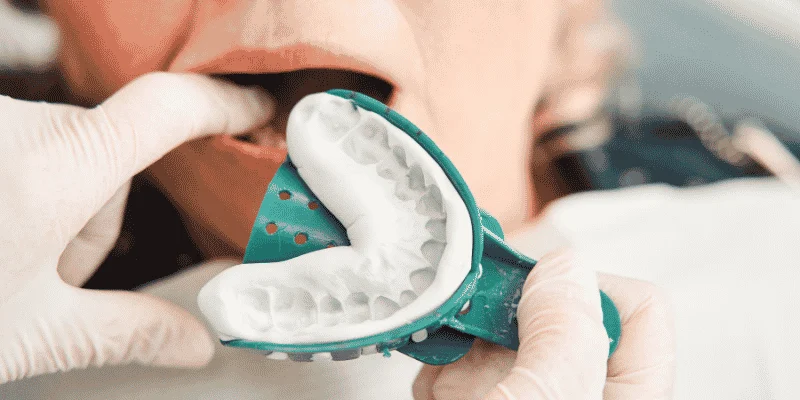
For successful implant restoration, your dentist takes impressions of your mouth to create a custom crown that matches your natural teeth.
You can choose between removable artificial teeth that snap onto the implant like dentures, or fixed teeth that are permanently screwed or cemented in place.
Maintaining your implant requires the same care as natural teeth. Use interdental brushes to clean around the implant and gum tissue. Schedule regular dental checkups so your dentist can monitor your implant health.
Avoid chewing hard items like ice or hard candy, and don’t smoke, as tobacco use can lead to implant failure.
Frequently Asked Questions
Many people have similar questions when thinking about dental implants. Cost, safety, and long-term success are among the top concerns.
Are dental implants a good choice for replacing missing teeth long-term?
Dental implants are a permanent solution designed to last for many years when properly cared for. The titanium post fuses with your jawbone through a process called osseointegration, creating a stable foundation that works just like a natural tooth root.
Most dental implants are successful and can last a lifetime with good oral hygiene. You’ll need to brush and floss regularly, just like you do with natural teeth.
Regular dental checkups help ensure your implants stay healthy. Your dentist can catch any issues early and provide professional cleanings to keep everything working properly.
What are the main reasons someone might decide not to get dental implants?
Cost is one of the biggest factors that stops people from getting implants. The upfront investment is higher than other tooth replacement options like dentures or bridges.
Some health conditions can affect bone healing, which makes you a poor candidate for implants. If you smoke tobacco, your risk of implant failure goes up significantly.
The process takes several months from start to finish. You’ll need multiple appointments and surgical procedures with healing time in between each stage.
Your jawbone needs to be strong enough to support the implant. If your bone is too thin or soft, you might need a bone graft first, which adds time and cost to the process.
What are the three main types of dental implants, and how are they different?
Endosteal implants are the most common type and go directly into your jawbone. These titanium screws look like small posts and work well for most patients with healthy jawbones.
Subperiosteal implants sit under your gum but on top of the jawbone. These are less common and might be an option if you don’t have enough healthy jawbone for traditional implants.
Zygomatic implants are the longest and most complex type. These anchor into your cheekbone instead of your jawbone and are typically used only when other options won’t work.
How much does a single tooth implant typically cost, and what factors affect the price?
A single tooth implant typically costs between $3,000 and $6,000 in the United States. This price usually includes the implant post, abutment, and crown.
Your location affects the cost significantly. Dental work in major cities tends to be more expensive than in smaller towns or rural areas.
If you need a bone graft before the implant, that adds $300 to $3,000 to your total cost. The type of crown material you choose also impacts the final price.
Most dental insurance plans don’t cover implants because they’re considered cosmetic. However, some plans may cover part of the crown or other portions of the procedure.
What side effects or risks can happen after getting a dental implant?
Swelling of your gums and face is normal after the surgery. You might also see bruising on your skin and gums, along with minor bleeding at the implant site.
Pain at the surgical site can last for several days. Your dentist will likely prescribe pain medication or recommend over-the-counter options to help you stay comfortable.
Infection at the implant site is possible but uncommon. You might need antibiotics before or after surgery to prevent this, especially if you have certain heart conditions or joint implants.
Nerve damage can cause numbness, tingling, or pain in your natural teeth, gums, lips, or chin.
Injury to surrounding structures like other teeth or blood vessels is another risk, though it’s rare when an experienced surgeon does the procedure.
If your implant is placed in the upper jaw, it could poke into one of your sinus cavities and cause sinus problems.
How much does it cost to replace all teeth with implants, and what full-mouth options are available?
Full-mouth dental implants typically cost between $24,000 and $100,000 per arch. The wide price range depends on how many implants you need and which type of restoration you choose.
The All-on-4 method uses four implants to support a full arch of teeth. This option costs less than placing individual implants for each tooth and requires less surgery time.
Implant-supported dentures snap onto several implants placed in your jaw. You can remove these for cleaning, which makes them easier to maintain than fixed options.
Fixed full-arch bridges are permanently attached to your implants. These give you the most natural feel but cost more than removable options.
The number of implants you need affects your total cost. Some people need six to eight implants per arch, while others can manage with four.