

Watching your teeth shift day by day can feel like waiting for water to boil. You know something is happening, but the change feels slow until suddenly it isn’t.
Your SureSmile treatment duration depends on how much tooth movement you need, your bite, and how consistently you wear your aligners.
Active treatment itself commonly runs between 6 and 18 months, with the exact number shaped by how much correction your smile needs and how closely you follow your wear schedule.
A SureSmile treatment plan is never one-size-fits-all, which is why a personalized assessment gives you a far more dependable answer than any general timeline.
The clearest way to know your own SureSmile timeline is a hands-on evaluation of your teeth, bite, and daily habits, since those three factors drive how fast your treatment moves.
This article breaks down what early progress looks like, how long different alignment issues typically take, and what can speed up or slow down your results.
Key Takeaways
- Early tooth movement often shows up in 8 to 12 weeks, but finished results usually take 6 to 18 months depending on your case.
- Daily wear time, oral hygiene, and how closely you follow your plan all affect whether treatment stays on schedule.
- A personalized consultation gives you a realistic timeline instead of a generic estimate.
When Will You Notice Changes in Your Smile?
Small shifts in tooth position often become noticeable within the first two to three months of wearing your aligners.
This early movement is a good sign that your treatment plan is working, though it’s only the beginning of your full smile transformation.
Every mouth responds a little differently. Patients with mild crooked teeth or minor misalignment sometimes see subtle changes even sooner, while more involved cases take a bit longer to show visible movement.
What Early Tooth Movement Can Look Like
In the first few weeks, you may notice a tooth that once overlapped its neighbor starting to sit flatter, or a small gap beginning to close. These early wins are usually modest, not dramatic.
Your dentist tracks this progress at scheduled check-ins, comparing your mouth to your original 3D scans.
This lets your care team confirm that your treatment timeline is on pace before moving you into your next set of trays.
Why Visible Progress and Finished Treatment Are Different
Noticing change is not the same as completing treatment. Teeth need time to settle fully into their new positions, and bite adjustments in particular take longer than cosmetic-looking shifts in the front teeth.
Some patients feel tempted to stop wearing their aligners once their smile “looks good enough.”
Stopping early can undo progress and stall correction of the underlying misalignment, so it’s worth sticking with your full treatment timeline even after you like what you see in the mirror.
Typical Treatment Length by Alignment Need
Treatment length depends on how much correction your teeth and bite need.
Minor alignment concerns may require less time than more involved crowding or bite problems, but your dentist can provide a more useful estimate after evaluating your teeth and planning the required movements.
Orthodontic treatment with SureSmile is built around your specific starting point, not a fixed calendar.
Mild alignment issues may be resolved in as little as six months, while more complex cases can take longer. Moderate cases, including more substantial crowding or bite issues, typically need around 12 to 18 months.
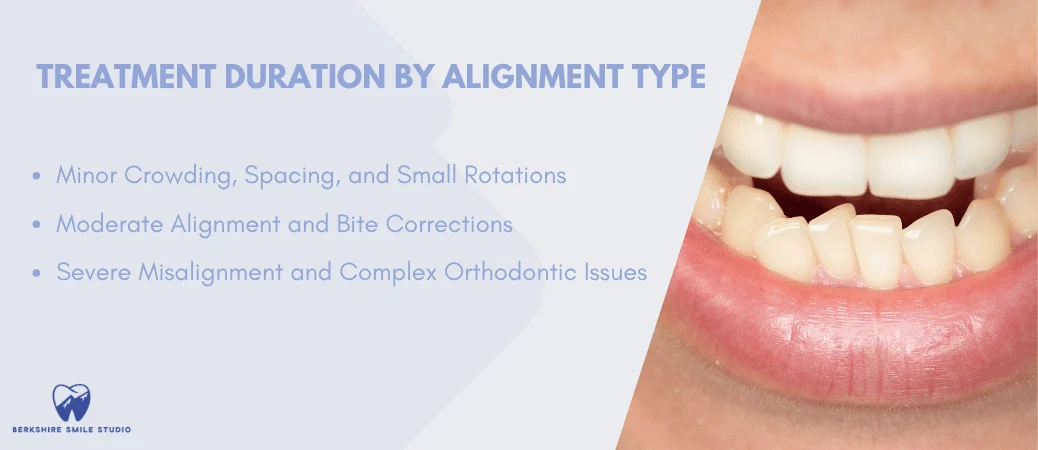
Minor Crowding, Spacing, and Small Rotations
Minor spacing, small rotations, and light crowding are usually the fastest cases to correct.
These orthodontic issues often wrap up in around 6 months, since the teeth need less distance to travel and fewer adjustments along the way.
Moderate Alignment and Bite Corrections
Moderate alignment issues, including a mild overbite or more noticeable crowding, generally take longer to resolve.
Expect a timeline closer to 12 to 18 months, since bite corrections require careful, gradual movement to protect your jaw joints and surrounding teeth.
Severe Misalignment and Complex Orthodontic Issues
Severe misalignment or complex malocclusion can push treatment toward the higher end of the range, and in some cases beyond what clear aligners alone can correct.
Your dentist will tell you plainly if your case may need traditional braces or a combination approach instead.
How SureSmile Moves Teeth on a Predictable Schedule
SureSmile relies on digital scans, 3D treatment planning, and a series of removable trays to move your teeth in small, predictable steps.
Each stage of your plan is mapped out before you ever put in your first aligner, which is part of why your orthodontist can give you a realistic treatment timeline early on.
Digital Scans and 3D Treatment Planning
Your treatment starts with digital scans of your teeth, which your dentist uses to build a 3D model of your mouth.
This model becomes the blueprint for treatment planning, showing exactly how each tooth needs to move and in what order.
Because the treatment is digitally planned, your dentist can review the planned tooth movements and discuss your expected treatment progression before you begin.
How Removable Trays and Aligner Changes Work
You’ll wear each set of clear aligners for about one to two weeks before switching to the next tray in your series.
Each new tray applies slightly more pressure, nudging your teeth a small step closer to their final position.
The trays are removable for eating, drinking, and brushing, which makes daily life with clear aligner treatment simpler than fixed appliances. That convenience only works in your favor if you’re consistent about putting them back in.
Why Check-In Visits and Refinements Matter
Regular check-in visits let your dentist confirm your teeth are moving as planned and catch any issues early.
If a tooth isn’t tracking exactly on schedule, your orthodontist may recommend refinements, which are additional aligners made partway through treatment to fine-tune results.
Refinements are a normal part of orthodontic care, not a sign that something went wrong. They simply help make sure your finished smile matches your original treatment plan.
What Can Keep Your Treatment on Track or Delay It?
Your daily habits have more influence on your SureSmile timeline than almost anything else. Wear time, oral hygiene, and how quickly you handle dental problems can each speed up or slow down your results.

Why Daily Wear Time and Patient Compliance Matter
Aligners need 20 to 22 hours of wear per day to keep treatment on schedule. Removing them only for eating, drinking beverages other than water, and brushing helps your teeth get the steady pressure they need.
Patient compliance is often the single biggest factor in whether treatment finishes on time. Skipping hours here and there adds up, and it may mean spending extra time in a tray before you’re ready to move forward.
Oral Hygiene and Oral Health During Aligners
Good oral hygiene protects both your teeth and your timeline. Food particles and plaque trapped under aligners can lead to decay or gum irritation, which may require pausing treatment to address.
Brushing after meals and before reinserting your trays keeps your mouth healthy throughout treatment.
Regular dental visits also let your team catch small oral health concerns before they become bigger problems.
When Dental Problems Need Prompt Attention
Some dental issues need an emergency dental appointment right away, even during aligner treatment.
Severe tooth pain, a knocked-out tooth, a lost filling, or other oral injuries should never wait for your next scheduled visit.
Prompt emergency dental care protects your overall treatment plan. Addressing problems quickly helps prevent delays and keeps your smile transformation moving forward safely.
SureSmile vs. Traditional Braces: What to Expect
SureSmile and traditional braces both straighten teeth effectively, but they differ in comfort, appearance, and how they fit into daily life.
SureSmile and traditional braces both straighten teeth, but treatment time varies according to the type and complexity of tooth movement required.
Your dentist can estimate which approach may fit your orthodontic needs and expected timeline.
| Feature | SureSmile Aligners | Traditional Braces |
| Average treatment time | 6 to 18 months | 18 to 24 months |
| Visibility | Clear, low-profile | Visible metal brackets |
| Removable | Yes | No |
| Daily eating restrictions | Minimal | Several food restrictions |
| Best for | Mild to moderate cases | Mild to severe cases |
Which Cases May Be Better Suited to Fixed Braces
Severe misalignment or complex bite issues sometimes respond better to traditional metal braces or clear braces.
Fixed appliances give an orthodontist more direct control over tooth movement, which can matter for more complicated corrections.
Convenience, Appearance, and Daily Care Differences
Clear aligners are far less noticeable day to day and can be removed for meals, brushing, and special occasions.
Traditional braces stay in place around the clock, which means more food restrictions but no risk of forgetting to wear them.
Maintaining Results With Retainers
Both treatment types require retainers afterward to keep your teeth from drifting back.
Wearing your retainer as directed protects the results you worked for, whether you’re also considering teeth whitening or a veneer consultation to complete your smile goals.
A Personalized Plan Gives You the Clearest Timeline

The most reliable way to know your SureSmile treatment time is a one-on-one evaluation with your dental team.
General ranges are helpful for setting expectations, but your actual suresmile timeline depends on your teeth, your bite, and your habits.
At Berkshire Smile Studio, treatment planning starts with a full look at your smile goals and oral health before any aligners are made.
This gives you a grounded, personalized estimate instead of a one-size-fits-all number pulled from an average case.
Berkshire Smile Studio also builds in regular check-ins throughout your orthodontic care, so small adjustments happen early rather than late.
That kind of steady oversight is part of what makes a projected timeline more than just a guess.
If you’re comparing options, it helps to see how SureSmile clear aligners work in more detail, or to review SureSmile vs braces side by side before your consultation.
Conclusion
Early tooth movement often shows up within 8 to 12 weeks, while full treatment typically wraps up somewhere between 6 and 18 months depending on your starting point.
Minor crowding and spacing tend to resolve faster, while moderate bite corrections and severe misalignment take more time and care.
Daily wear time, good oral hygiene, and prompt attention to dental problems all help keep your treatment on schedule.
Whether you’re leaning toward clear aligners or comparing them with traditional braces, a personalized evaluation with Berkshire Smile Studio gives you the clearest, most honest picture of what your own smile transformation will look like.
Frequently Asked Questions
How soon will I see results with SureSmile?
Many patients notice subtle tooth movement within 8 to 12 weeks of starting treatment. Full results take longer, generally between 6 and 18 months, depending on how much correction your smile needs.
How many hours a day should I wear SureSmile aligners?
SureSmile aligners work best when worn 20 to 22 hours per day, removing them only for eating, drinking, and brushing. Consistent wear time is one of the biggest factors in keeping your treatment on schedule.
Is SureSmile as effective as traditional braces?
SureSmile and traditional braces can both produce excellent, healthy smiles, though each suits different cases.
Clear aligners work well for mild to moderate alignment issues, while traditional braces may be recommended for more severe or complex orthodontic problems.
Can SureSmile fix an overbite or severe crowding?
SureSmile can correct many cases of overbite and crowding, particularly mild to moderate ones.
Severe crowding or complex malocclusion sometimes requires traditional braces or a combination approach, which your dentist can determine during your consultation.
Do I need to wear a retainer after SureSmile treatment?
Yes, retainers are an essential part of keeping your results after SureSmile treatment.
Teeth can drift back toward their original position without consistent retainer wear, so following your dentist’s retention schedule protects the smile you worked to achieve.