
Missing teeth can make eating difficult and affect your confidence when smiling. Dental implants offer a permanent solution that looks and feels like your natural teeth, but choosing the right type can seem overwhelming with so many options available.
There are several main types of dental implants, including endosteal, subperiosteal, and zygomatic implants, each designed for different bone conditions and tooth replacement needs.
Dental implants range from single-tooth replacements to full-mouth solutions like All-on-4 implants systems.
Understanding your options helps you make the best choice for your specific situation.
Your dentist will consider factors like your jawbone health, the number of missing teeth, and your budget to recommend the most suitable implant type for restoring your smile.
Key Takeaways
- Endosteal implants are the most common type and work best when you have a healthy jawbone to support them.
- Different implant solutions exist for replacing single teeth, multiple teeth, or full mouth restoration, depending on your needs.
- Your dentist will choose the right implant type based on your jawbone condition, oral health, and specific tooth replacement goals.
Overview of Dental Implants
Dental implants are titanium posts that replace missing tooth roots, providing a stable foundation for artificial teeth.
They work by fusing with your jawbone through a natural healing process, creating a permanent solution that protects your oral health.
What Are Dental Implants?
A dental implant is a small titanium screw that your dentist places into your jawbone where you have missing teeth. Think of it as an artificial tooth root.
The implant itself has three main parts:
- Implant post: The titanium screw that goes into your jawbone
- Abutment: A connector piece that attaches to the implant
- Crown: The artificial tooth that sits on top
Most implants are made of titanium because it works well with your body. Your bone actually grows around the titanium over time.
Some newer implants use zirconia, which is a white ceramic material. These look more natural because they don’t show any metal through your gums.
How Dental Implants Work
Your dentist first makes a small hole in your jawbone where your missing tooth used to be. They then place the titanium implant into this hole.
Over the next 3 to 6 months, your jawbone grows around the implant. This process is called osseointegration.
The healing process happens in stages:
- Week 1-2: Initial healing of gum tissue
- Month 1-3: Bone starts growing around the implant
- Month 3-6: Complete bone fusion occurs
Once your bone has fully healed around the implant, your dentist attaches the abutment. Then they place your new artificial tooth on top.
The implant becomes part of your jawbone. This makes it as strong as your natural tooth roots.
Benefits for Oral Health

Dental implants help keep your jawbone healthy by providing the stimulation it needs. When you lose teeth, your jawbone begins to shrink because it’s no longer being used.
Key oral health benefits include:
- Prevents bone loss in your jaw
- Keeps nearby teeth from shifting
- Makes cleaning easier than bridges
- Protects your facial structure
Research shows that implants have a success rate of 95-98% over 10 years, making them very reliable. They don’t get cavities like natural teeth, but you still need to brush and floss around them.
Your remaining natural teeth stay healthier because implants don’t require grinding down nearby teeth as bridges do. This preserves more of your natural tooth structure.
Implants also help you chew food properly, which is important for good digestion and nutrition.
Major Types of Dental Implants
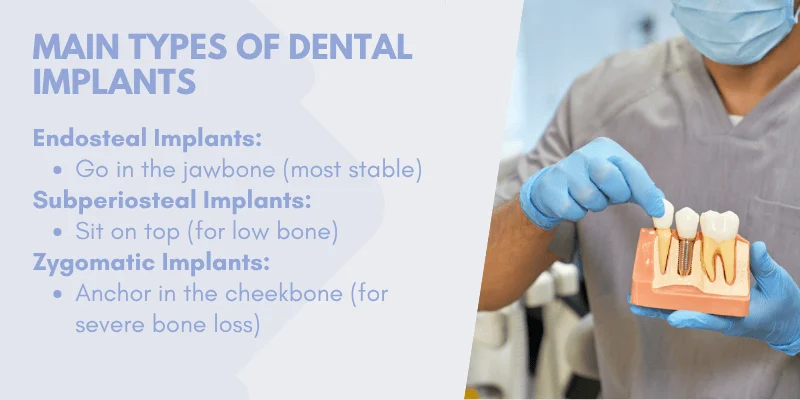
Dental implants come in three main forms that work with different jawbone conditions. Endosteal implants go directly into your bone, subperiosteal implants sit on top of your jawbone, and zygomatic implants anchor into your cheekbone.
Endosteal Implants
Endosteal implants are the most common type you’ll encounter today. These titanium screws are surgically inserted directly into your jawbone, where they act as artificial tooth roots.
Your jawbone grows around the implant through a process called osseointegration. This creates a strong foundation for your new tooth. The entire process typically takes several months.
Research shows that endosteal implants, including ceramic and titanium screw/blade types, can integrate well with bone and remain functional for long periods (up to 10 years in humans).
However, outcomes vary depending on bone quality/quantity, surgical technique, and patient health. For example, bone loss or poor vascularization (e.g., after prolonged toothless periods) can increase the risk of failure.
Key Benefits:
- Most stable and durable option
- Natural feel and function
- Long-lasting results
You’ll need adequate bone density for endosteal implants to work properly. If your jawbone is too thin or soft, your dentist may recommend bone grafting first. This procedure adds material to strengthen your jaw before implant placement.
Most people are good candidates for endosteal implants. They work well for single teeth, multiple teeth, or even full mouth restorations.
Subperiosteal Implants
Subperiosteal implants are a rare alternative when your jawbone can’t support traditional implants. Instead of going into your bone, these implants sit on or above your jawbone, underneath your gums.
Your dentist places a metal framework on top of your jawbone. Posts extend through your gums to hold the artificial teeth. This approach works when you have significant bone loss.
When You Might Need Subperiosteal Implants:
- Insufficient jawbone density
- Unable to undergo bone grafting
- Multiple failed endosteal implants
The procedure is less invasive than endosteal implants since no drilling into bone is required. However, they’re not as stable or long-lasting as implants placed directly in bone.
Your healing time is typically shorter with subperiosteal implants. Most people can return to normal activities within a few weeks.
Zygomatic Implants
Zygomatic implants offer a solution when your upper jawbone lacks sufficient density for traditional implants. These longer implants anchor directly into your zygomatic bone, which is located in your cheekbone area.
The procedure is more complex than standard implant surgery. Your oral surgeon needs specialized training to place zygomatic implants safely. They’re typically used for full upper jaw restoration.
Advantages of Zygomatic Implants:
- No bone grafting required
- Immediate tooth replacement is possible
- Works with severe bone loss
You might be a candidate if you’ve lost significant bone in your upper jaw due to gum disease, injury, or long-term tooth loss. The zygomatic bone is denser and more stable than your regular jawbone.
Recovery takes longer than standard implants, but the results can be life-changing. Many people can avoid extensive bone grafting procedures by choosing this option instead.
Implant Solutions for Specific Needs
Different dental implant options address various tooth replacement scenarios, from single missing teeth to complete arch restoration. Each solution offers unique benefits based on your specific dental condition and treatment goals.
Single-Tooth Implants
A single implant provides the most natural replacement for one missing tooth. The titanium post acts as an artificial root that supports a custom crown.
Key Benefits:
- Preserves adjacent healthy teeth
- Prevents bone loss in the jaw
- Functions like your natural tooth
- Lasts 20+ years with proper care
The procedure involves placing the implant directly into your jawbone where the tooth root was located. After healing for 3-6 months, your dentist attaches the crown.
Single-tooth implants work best when you have adequate bone density and healthy gums. They offer superior stability compared to removable partial dentures.
Your new tooth will match your existing teeth in color and shape. You can eat, speak, and smile with complete confidence.
Implant-Supported Bridge
An implant-supported bridge replaces multiple adjacent missing teeth by anchoring onto dental implants rather than natural teeth. This option typically replaces 3-4 consecutive teeth using 2-3 implants.
Treatment Timeline:
- Initial consultation and planning
- Implant placement surgery
- 3-6 month healing period
- Bridge fabrication and placement
Unlike traditional bridges, implant-supported bridges don’t require grinding down healthy adjacent teeth. This preserves your natural tooth structure.
The implants distribute chewing forces evenly, reducing stress on individual posts. This makes the restoration more durable than single implants supporting multiple crowns.
You’ll receive a temporary bridge during healing to maintain your appearance and basic function. The final bridge offers excellent stability for eating and speaking.
All-on-4
The All-on-4 implant system provides full-arch restoration using just four strategically placed implants per jaw. This technique supports a complete set of fixed teeth.
All-on-4 Advantages:
- Immediate function – Temporary teeth same day
- No bone grafting – Uses available bone efficiently
- Cost-effective – Fewer implants than traditional methods
- Faster healing – Less surgical sites
The back implants are angled to maximize contact with existing bone. This eliminates the need for bone grafting in most cases.
You’ll leave your appointment with temporary teeth that allow normal eating and speaking. The final prosthetic is placed after 3-6 months of healing.
All-on-4 works well if you’re missing most or all teeth in one arch. It provides excellent stability compared to traditional dentures.
Mini Implants
Mini dental implants (MDIs) measure less than 3mm in diameter, making them ideal for patients with limited bone width or those seeking a less invasive option.
Mini Implant Features:
- Single-piece design
- Immediate loading possible
- No bone grafting required
- Lower cost than standard implants
The smaller size allows placement in areas where traditional implants won’t fit. This includes narrow spaces between teeth or areas with minimal bone.
Mini implants offer a practical solution while ensuring stability and functionality. They’re commonly used to stabilize loose dentures or replace small front teeth.
Your dentist can often complete the entire procedure in one visit. This reduces treatment time and overall discomfort compared to conventional implants.
Mini implants work especially well for lower denture stabilization, eliminating the sliding and clicking associated with loose-fitting dentures.
Ready to explore your implant options? Schedule a consultation today and get a personalized treatment plan.
Supporting Procedures and Materials
Getting dental implants often requires additional steps to ensure your new tooth functions well and lasts long. You might need bone grafts to strengthen your jaw, special parts to connect the implant to your crown, and different types of pain control during surgery.
Bone Grafting and Augmentation
Your jawbone needs to be strong enough to hold a dental implant. When you lose a tooth, bone loss starts right away in that area.
A bone graft adds new bone material to weak spots in your jaw. Your dentist takes bone from another part of your body or uses special bone products.
Types of bone grafts include:
- Your own bone from your hip or chin
- Donor bone from a bone bank
- Animal bone that’s been processed
- Man-made bone materials
Bone grafting usually takes 3-6 months to heal before you can get your implant. The new bone grows together with your existing jawbone during this time.
Some people need sinus lifts if they’re getting implants in their upper back teeth. This procedure adds bone to the area under your sinuses.
Abutment and Dental Crown Options
An abutment connects your implant to your new tooth. This small piece screws into the top of your implant after it heals into your jawbone.
Your dentist picks the right abutment based on where your implant is and what kind of crown you need. Different materials work better for different situations.
Common abutment materials:
- Titanium – Strong and works well with implants
- Zirconia – Tooth-colored and good for front teeth
- Gold – Lasts long but costs more
Your dental crown is the part that looks like your real tooth. It sits on top of the abutment and does all the work of chewing and biting.
Crowns can be made from porcelain, metal, or a mix of both. Porcelain crowns look the most natural but metal ones last longer.
Dental Implant Surgery and Anesthesia
Dental implant surgery usually happens in your dentist’s office. The procedure involves several steps and may take multiple visits to complete.
Most implant surgery uses local anesthesia to numb the area around your implant site. You stay awake but don’t feel any pain during the procedure.
Pain control options include:
- Local shots to numb your gums and jaw
- Nitrous oxide (laughing gas) to help you relax
- Oral sedation pills taken before surgery
- IV sedation for people who are very nervous
Your dentist makes a small cut in your gum and drills a hole in your jawbone. The implant is placed into this hole, and your gum is sutured back up.
Most people can go back to work the next day after dental implant surgery. You’ll get pain medicine and special care instructions to help you heal properly.
Comparing Dental Implants to Other Tooth Replacement Options
When you lose a tooth, you have three main choices to replace it. Dental implants offer better long-term benefits than dentures or bridges, though they cost more upfront.
Dental Implants vs. Dentures
Dentures are removable teeth that sit on your gums. They’re cheaper at first but need replacing every 5-7 years.
Dental implants attach directly to your jawbone. They last 25 years or longer with good care.
| Feature | Dental Implants | Dentures |
| Lifespan | 25+ years | 5-7 years |
| Bone preservation | Yes | No |
| Eating ability | Full function | Limited |
| Daily care | Brush like normal teeth | Remove and soak |
Dentures can slip when you eat or talk. This makes it hard to enjoy foods like corn on the cob or apples.
Implants feel like your natural teeth. You can eat whatever you want without worry.
Your jawbone shrinks when you wear dentures because there’s no tooth root. Dental implants prevent bone loss by acting like natural roots.
Dental Implants vs. Dental Bridges
A dental bridge uses your healthy teeth next to the gap as anchors. The dentist removes enamel from these teeth to fit crowns.
Dental bridges last about 10-15 years before needing replacement. You’ll need to replace them multiple times during your life.
Bridges are harder to clean because they connect multiple teeth together. You need special floss threaders to clean under the bridge.
Implants don’t affect your other teeth. Each implant stands alone, and you can floss normally around it.
Dental bridges cost less initially, but implants save money over time. You won’t need costly replacements every decade.
The teeth supporting your bridge can develop problems over time. This might mean losing more teeth later.
Take the first step toward a lasting, healthy smile.
Schedule a free consult today and discover whether implants are right for you.
How to Choose the Right Dental Implant Type
The right implant depends on your bone density, oral health, and specific tooth-replacement needs. Working with qualified implant specialists ensures you get the most suitable option for your situation.
Factors to Consider
Your bone density plays the biggest role in choosing the type of dental implants. Strong, thick jawbone supports endosteal implants best. A thin or weak bone may require subperiosteal or zygomatic implants instead.
Your overall oral health affects healing and success rates. Healthy gums without disease heal faster after implant surgery. If you have gum disease, you’ll need treatment first.
The number of missing teeth matters too. Single-tooth loss can be managed with a single endosteal implant. Multiple missing teeth might need several implants or a bridge. Full mouth tooth loss often works best with All-on-4 or All-on-6 systems.
Key factors include:
- Amount and quality of jawbone
- Gum health and disease status
- Number of teeth needing replacement
- Your age and healing ability
- Budget and insurance coverage
- Time available for treatment
Your lifestyle also matters. Active people often prefer permanent implants over removable options.
Consulting Implant Specialists

Implant specialists have advanced training in placing different implant types. They use special scans and X-rays to check your bone density and plan treatment. General dentists may refer complex cases to specialists.
During your consultation, the specialist will examine your mouth and take detailed images. They’ll measure your bone thickness and height. This helps them pick the best implant type for you.
Specialists can provide:
- 3D scans of your jawbone
- Bone density measurements
- Treatment timeline planning
- Success rate predictions for your case
The specialist will explain your options and recommend the best approach. They’ll discuss healing time, costs, and what to expect. Some specialists offer multiple implant types in their practice.
Ask about their experience with your specific implant type. More experienced specialists often have higher success rates with complex cases.
Meet our implant specialists in Pittsfield, MA.
Get a personalized treatment plan with advanced 3D imaging. Schedule your consultation now.
Frequently Asked Questions
Dental implant types vary in materials, crown options, and placement methods that affect both cost and success rates. Understanding single versus multiple implant options, titanium versus ceramic materials, and brand differences helps you make informed decisions about your tooth replacement.
What are the differences between single, multiple, and full mouth dental implants?
Single dental implants replace one missing tooth with an individual titanium post and crown. You get a standalone solution that doesn’t affect your other teeth.
Multiple implants can support bridges or partial dentures when you’re missing several teeth. The three main types include single implants, implant-supported bridges, and implant-supported dentures that replace different numbers of teeth.
Full mouth implants use four to eight implants per jaw to support complete dentures. This option works well when you’ve lost most or all of your teeth.
The number of implants you need depends on how many teeth you’re replacing. Your jawbone density and overall oral health also influence the treatment plan.
How do the materials used in dental implants affect their longevity and performance?
Titanium implants are the most common choice because they bond well with your jawbone. This metal has been used successfully for decades and rarely causes allergic reactions.
Ceramic implants made from zirconia offer a metal-free alternative. They look more natural but may not be as strong as titanium in high-stress areas.
A dental implant comprises three parts: a titanium or ceramic post, an abutment, and a restoration that work together like natural tooth roots.
Titanium typically lasts longer because it’s stronger and more research supports its use. Ceramic implants are newer but show promise for people with metal sensitivities.
Can you explain the various types of dental implant crowns and how to choose the right one?
Porcelain crowns look the most natural and resist stains well. They’re ideal for front teeth where appearance matters most.
Metal crowns are very strong but look silver or gold. Dentists often use them for back teeth that handle heavy chewing forces.
Porcelain-fused-to-metal crowns combine strength with natural appearance. The metal base provides durability while the porcelain coating looks like real teeth.
Zirconia crowns offer both strength and natural looks. They’re becoming more popular because they don’t contain metal and match tooth color well.
Your dentist will consider the implant location, your bite force, and your budget when choosing crown materials. Front teeth usually need more natural-looking options than back teeth.
What should I expect in terms of cost for different dental implant options?
Single implants typically cost between $3,000 and $5,000 each including the post, abutment, and crown. This price varies by location and dentist experience.
Multiple implants cost less per tooth when you need several replacements. Implant-supported bridges often range from $6,000 to $15,000 depending on how many teeth they replace.
Full mouth implants can cost $20,000 to $50,000 per jaw. The exact price depends on how many implants you need and the type of restoration.
Insurance may cover part of the crown but rarely pays for the implant itself. Many dental offices offer payment plans to help spread costs over time.
Material choices affect pricing too. Premium materials like zirconia crowns cost more than standard porcelain options.
Could you provide an overview of the most popular dental implant brands available?
Straumann is a Swiss company known for high-quality implants with excellent success rates. Their implants often cost more but have strong research backing.
Nobel Biocare pioneered many implant techniques and offers various implant sizes. They’re widely used by dentists around the world.
Zimmer Biomet provides reliable implants at moderate prices. Many dentists choose this brand for its good balance of quality and cost.
Hiossen offers quality implants with comprehensive patient education resources. You can receive answers to common questions about their dental implant systems to learn more about treatment options.
Your dentist’s experience with specific brands matters more than the brand name itself. Most major brands have similar success rates when placed properly.
Are there dental implants designed for specific conditions like bone density issues?
Mini implants work well when you have limited bone density or narrow spaces. They’re smaller than regular implants but still provide good stability for certain situations.
Zygomatic implants anchor in your cheekbone instead of your jaw when you don’t have enough upper jawbone. This option avoids the need for bone grafting procedures.
Short implants help when you have limited vertical bone height. They’re designed to work in smaller spaces while still providing strong support.
Most dental implants are designed to be permanent with proper care, though some types like mini implants may have shorter lifespans depending on their specific use.
Your oral surgeon will evaluate your bone density with CT scans before recommending implant types. Bone grafting can also improve your candidacy for standard implants if needed.