


If you have several failing teeth, or dentures that shift every time you eat, you have probably wondered whether there is one plan that fixes everything at once.
There is, and it has a name: full mouth reconstruction using dental implants.
The process is slower and more thoughtful than most people expect. An implant dentist starts by sorting out what can be saved, what has to go, and how much jawbone is left to work with.
Only after that does anyone talk about new teeth.
The core idea behind full mouth implant restorations is that implants replace tooth roots, so your replacement teeth are anchored in bone instead of resting on gum tissue. This can provide greater stability for chewing, speaking, and everyday function.
Tooth loss is common, and the reasons behind it vary: decay, gum disease, grinding, old dental work that has run out of life. The plan has to match the cause, not just the missing teeth.
Key Takeaways
- Implants act as artificial tooth roots, which is why fixed full-arch teeth feel steadier than traditional dentures.
- Careful diagnosis, 3D imaging, and a coordinated care team come before any surgery is scheduled.
- Most full-mouth cases span several months, with temporary teeth bridging the gap until the final restoration is ready.
Table of Content
- What a Full Mouth Restoration Can Replace
- Who Needs Comprehensive Implant Care?
- How the Dental Team Plans a Predictable Result
- From Extractions to the Final Prosthesis
- Recovery, Maintenance, and Long-Term Value
- A Restored Smile Starts With a Personalized Plan
- Frequently Asked Questions
What a Full Mouth Restoration Can Replace
A full mouth restoration can rebuild damaged natural teeth, replace an entire arch of missing teeth, or do both in the same treatment plan.
The goal is a stable bite, comfortable chewing, and speech clarity that you stop thinking about.
Rebuilding Damaged Teeth vs. Replacing an Entire Arch
Keeping healthy teeth is almost always the first choice. If a tooth has a solid root and enough structure, a crown, a filling, or root canal treatment can keep it working for years.
Some mouths have a mix: a few strong teeth up top, nothing salvageable on the bottom. A plan like that might combine crowns, a bridge, and a full arch of implants.
When teeth are loose, cracked at the gumline, or held in place by little more than habit, removing them and rebuilding the arch gives a more predictable result than patching each one.
Fixed Full Arch Restoration vs. Traditional Dentures
Both replace a full set of teeth. How they stay put is where they part ways.
| Fixed Full Arch on Implants | Traditional Dentures | |
| Support | 4 to 6 implants in bone | Gum tissue and suction |
| Removable by you | No | Yes |
| Covers palate | Usually no | Upper plate does |
| Bone preservation | Helps maintain bone | Bone continues to shrink |
| Adjustments over time | Periodic checks | Relines as gums change |
Ill-fitting dentures are one of the most common reasons people ask about implants. If you want a closer look at the trade-offs, this comparison of dental implants and dentures covers cost, comfort, and daily care.
How Implants Replace Tooth Roots and Support Artificial Teeth
Each implant is a small titanium post placed in the jawbone, where a natural tooth root used to sit. Bone grows tightly against it, which gives the post real biting strength.
Abutments connect the posts to the prosthetic teeth above. With full mouth dental implants, a handful of implants can carry an entire arch of artificial teeth as one solid unit.
Because the posts sit in bone, chewing pressure travels into the jaw the way it did with your natural teeth. That stimulation is what slows the bone shrinkage that follows tooth loss.
Who Needs Comprehensive Implant Care?
Comprehensive implant care makes sense when problems are spread across your whole mouth instead of centered on one or two teeth.
A dental examination sorts out whether you are a candidate today, or a candidate after some groundwork.
When Failing Teeth, Decay, or Tooth Loss Call for a Bigger Plan
Tooth-by-tooth repair starts to break down when each fix puts stress on the next weak tooth.
Signs you have crossed that line include multiple broken teeth, repeated crown failures, and chewing that has narrowed down to soft foods.
Widespread decay below old fillings is another marker. So is a bite that has collapsed, where teeth have worn short and your face looks shorter than it used to.
If you have already lost back teeth on both sides, the front teeth take a beating they were never built for.
How Gum Disease, Bruxism, and TMJ Affect Candidacy
Periodontal disease has to be treated before implants go in. Active infection in the gums raises the risk of the same inflammation attacking an implant later, so periodontal care usually comes first in the sequence.
Bruxism, or heavy grinding, does not disqualify you. It does change the design: stronger materials, a more protective bite scheme, and a night guard you wear from day one.
TMJ pain calls for a careful look at jaw position before anything permanent is built. Locking in a new bite on top of an unstable joint invites soreness and cracked prosthetic teeth.
Can You Get Implants With Bone Loss?
Often, yes. Jawbone loss is expected after teeth have been missing for a while, and there are several ways around it.
Grafting rebuilds width or height. Angled placement can find dense bone in spots that look thin on a flat X-ray. In upper jaws with very little bone, zygomatic implants anchor into the cheekbone instead.
3D scans measure bone density in precise terms, which is why guesswork has largely left this part of planning.
How the Dental Team Plans a Predictable Result
Planning starts with the finished smile and works backward to implant positions. This prosthetic-led approach is the main reason full-mouth cases succeed or disappoint.
Digital Imaging and the Comprehensive Dental Examination
Your first appointment gathers records: a cone beam CT scan, digital photos, intraoral scans, and a full periodontal charting. The scan shows bone volume, nerve location, and sinus position in three dimensions.
Diagnostic images catch problems that are invisible during a visual exam, which is why thorough records and X-rays come before any treatment decisions.
We also record how your teeth meet, where your lips fall at rest, and how much your tooth shows when you smile.
Planning the Smile, Bite, and Facial Support Before Surgery
Digital smile design lets you preview tooth shape, length, and position on screen before a single implant is placed. That preview becomes the blueprint for surgery.
Facial support matters here. Years of bone loss can flatten the area around the lips, and the prosthesis design can restore some of that fullness.
Bite alignment gets mapped next: where your jaw closes comfortably, how the back teeth share the load, and how much room exists for the new teeth.
At Berkshire Smile Studio, this planning phase is where most of your questions get answered, long before surgery day.
When an Oral Surgeon, Periodontist, and Prosthodontist Work Together
Full-arch cases pull in several sets of hands. A surgeon or periodontist handles extractions, grafting, and implant placement. A prosthodontist or restorative dentist designs and delivers the teeth.
Your general dentist stays in the loop for cleanings and long-term monitoring. Choosing an implant dentist who coordinates these roles, and shares one treatment plan across them, keeps surgery and prosthetics aligned.
From Extractions to the Final Prosthesis
The surgical phase follows a set order: prepare the site, place the implants, wait for the bone to bond, then build the final teeth. Rushing any step costs you later.
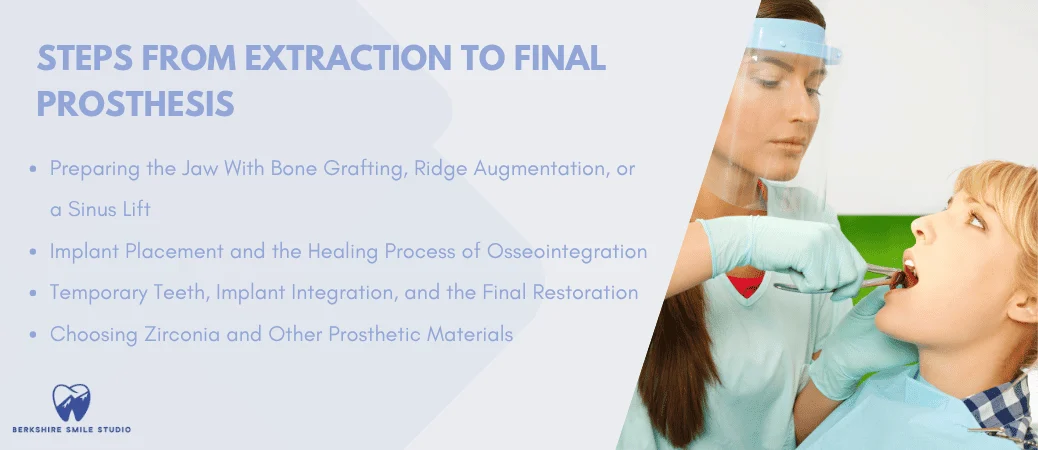
Preparing the Jaw With Bone Grafting, Ridge Augmentation, or a Sinus Lift
Not every case needs grafting. When it does, the type depends on what is missing.
- Socket grafting fills the space right after tooth extractions to preserve ridge shape.
- Ridge augmentation widens or builds up a jaw ridge that has thinned.
- Sinus lift raises the sinus floor to create height for upper back implants.
Graft sites need healing time, commonly a few months, before implants go in. Some smaller grafts happen at the same visit as implant placement.
Implant Placement and the Healing Process of Osseointegration
Surgery happens under local anesthesia, sedation, or both. Guided templates made from your 3D scan help the surgeon place each implant in the exact position the plan calls for.
Then bone does the slow work. Osseointegration, the fusion of bone to the implant surface, takes roughly three to six months.
You do not go without teeth during that stretch.
Temporary Teeth, Implant Integration, and the Final Restoration
Many patients receive a temporary fixed bridge the same day their implants are placed. It looks like teeth and functions well enough for a soft diet.
That temporary set does double duty as a test drive. Speech, lip support, and tooth length all get evaluated and tweaked while the bone heals.
Once integration is confirmed, new impressions or scans capture the healed implant positions. The final restoration is stronger, more precisely fitted, and built to handle a normal diet.
The dental implant procedure timeline shifts from patient to patient, so your dates come from your own healing, not an average.
Choosing Zirconia and Other Prosthetic Materials
Zirconia is the most common choice for full-arch teeth today. It resists chipping, holds its color, and polishes to a surface that stays clean.
Other options include titanium frameworks with acrylic teeth, which cost less and are easier to repair, and porcelain-fused-to-metal for smaller segments. Heavy grinders often do better in monolithic zirconia.
Material choice also affects repair. Acrylic teeth can be replaced chairside; a fractured zirconia arch goes back to the lab.
Recovery, Maintenance, and Long-Term Value
Recovery from full-mouth implant surgery is manageable for most patients, with the roughest stretch behind you inside a week. The longer commitment is daily cleaning and regular checkups.
What Recovery After Full Mouth Implant Surgery Is Really Like
Expect swelling that peaks around day two or three, bruising along the jaw, and soreness that responds to prescribed medication. Ice for the first 48 hours helps more than people expect.
Soft foods for several weeks: eggs, yogurt, soups, well-cooked pasta. Skip straws, smoking, and chewy foods while the tissue closes.
Treating both arches at once means one healing period instead of two, with initial healing running about two to three weeks.
Daily Cleaning Habits That Protect Implant Restorations

Brushing and flossing still apply, with a few additions. The area where the prosthesis meets your gums traps debris, and that spot needs deliberate attention.
- Brush twice daily with a soft brush, including along the gumline
- Run a water flosser under and around the bridge once a day
- Use interdental brushes or superfloss threaders where access is tight
- Wear your night guard if grinding is part of your history
- Keep hygiene visits on schedule, often every three to four months
More guidance on dental implant care covers the tools worth buying and the ones you can skip.
The American Dental Association recommends twice-daily brushing and daily cleaning between teeth for everyone, implants included.
How Much Do Full Mouth Dental Implants Cost?
Full mouth implant treatment is a significant investment, and the range is wide because the work varies so much. Grafting, sedation, number of implants, and material choice all move the number.
Costs depend on your specific case, so a written treatment plan after your exam is the only accurate figure.
Many practices, including Berkshire Smile Studio, review financing options during the planning visit so the numbers are clear before you commit.
Medical credit lines, personal loans, and in-house payment plans are the usual routes.
Understanding Risks, Repairs, and Follow-Up Care
Implants have strong long-term success rates, and complications still happen. Peri-implantitis, the gum and bone infection around an implant, is the main threat to longevity.
Other issues: a screw loosening, a chipped tooth on the prosthesis, or a single implant failing to integrate. Most are fixable, and catching them early keeps the fix small.
Plan on checkups where your family dentist removes or inspects the prosthesis, cleans underneath, and takes periodic X-rays to watch bone levels.
A Restored Smile Starts With a Personalized Plan
Full mouth reconstruction works because of sequence: diagnose carefully, treat gum disease and bone deficiencies first, place implants in planned positions, then build teeth designed around your bite and face.
Full mouth dental implants are one path through that sequence, not the only one. Some readers will keep more of their natural teeth than they expected; others will find a fixed arch is the cleaner solution.
Treatment planning is where those answers come from, and it takes records, measurements, and a conversation about what you want your mouth to do.
Bring your questions about timing, cost, and healing to a consultation at Berkshire Smile Studio, and ask to see the 3D scan of your own jaw while you talk it through.
Frequently Asked Questions
How long does a full mouth dental implant process take?
Most cases run from about four months to a year or more, depending on healing and whether grafting is needed.
Osseointegration alone takes roughly three to six months. Extractions, grafts, and lab fabrication of the final teeth add to the timeline.
How painful is full mouth dental implant surgery?
The surgery itself is done under anesthesia or sedation, so you should not feel pain during placement.
Afterward, expect soreness and swelling for several days, managed with prescribed or over-the-counter medication. Most patients describe it as more manageable than a difficult extraction.
Can I receive temporary teeth on the day of implant surgery?
Many patients do, using a fixed temporary bridge attached to the implants the same day. It requires enough bone stability at placement, which your 3D scan helps determine ahead of time.
You will follow a soft diet while wearing it.
What is the number one reason dental implants fail?
Peri-implantitis, the infection of gum and bone around an implant, is the leading cause of late failure. It starts with plaque buildup that daily cleaning and professional visits would have removed.
Smoking and uncontrolled diabetes raise the risk considerably.
Does insurance cover full mouth dental implants?
Dental insurance sometimes covers portions of the treatment, like extractions or a prosthesis, while excluding implants as cosmetic. Annual maximums on most plans fall far short of full-mouth treatment costs.
Your office can submit a pre-treatment estimate so you know your share before starting.
What is the downside of full mouth dental implants?
Cost and treatment length are the two biggest drawbacks, along with the need for surgery.
You also take on lifelong maintenance, including specialized cleaning and periodic prosthesis service. For patients with health conditions that impair healing, implants may not be the right fit.