

Missing a tooth can feel stressful, and finding the right dentist to fix it can feel even harder.
The best way to choose an implant dentist is to look at their training, technology, patient reviews, and pricing before you commit to care.
Dental implants are a big decision for your oral health, so it helps to know what to look for before you sit in the chair.
You want a dentist who does more than just place an implant. You want someone who explains your options, listens to your concerns, and helps you feel confident about your smile.
Taking time to compare a few options, like checking reviews and results in a smile gallery, can help you spot the difference between an average provider and a great one.
This guide walks you through the simple steps for choosing the right implant dentist.
You’ll learn what questions to ask, what to look for in a consultation, and how to compare dental implant costs and provider options without feeling overwhelmed.
By the end, you’ll know exactly how to pick a dentist who fits your needs and your budget.
Key Takeaways
- A dentist’s training and experience with implants can affect how well your treatment turns out.
- Modern planning tools and a clear treatment plan can make your procedure smoother and more predictable.
- Comparing patient reviews, costs, and long-term support can help you feel confident in your final choice.
Start With Qualifications, Training, and Experience
Not every dentist has the same level of skill when it comes to implants.
Before you book an appointment, take a little time to check the dentist’s background, training, and how many implant procedures they have actually done.
Verify Advanced Implant Dentistry Training
Dental school teaches the basics, but implant dentistry needs extra training after that. Many dentists take courses that focus only on implants, and this can add up to hundreds of hours of learning.
Ask your dentist what kind of training they have completed. You want someone who has studied implant placement, bone grafting, and how to restore the tooth after the implant heals.
Don’t be afraid to ask direct questions. A good dentist will be happy to explain their background and show proof if you ask.
Ask About Experience With Similar Implant Procedures
Training is important, but hands-on experience matters just as much. You want an experienced implant dentist who has handled cases similar to yours.
If you need a single tooth replaced, ask how many single-implant cases they have done. If you need multiple implants or a full arch, ask about that specific type of work too.
Every mouth is different, and some cases are more complex than others.
A dentist for dental implants who has worked with jawbone loss, gum disease, or other complications will be better prepared to handle unexpected issues.
Look for Continuing Education and Professional Memberships
Implant dentistry changes over time as new tools and techniques become available. A dentist who keeps learning is more likely to give you updated, safe care.
Look for memberships in groups for ongoing education and case reviews to maintain certain credentials. These memberships are not required by law, but they show a dentist is serious about staying sharp in their field.
At Berkshire Smile Studio, Dr. Shakil Syed brings over 12 years of dental experience and advanced training in implant dentistry.
A graduate of Columbia University College of Dental Medicine, he has completed the Maxicourse in Implantology and is a member of the American Academy of Implant Dentistry. .
This kind of commitment often means better results and fewer surprises during treatment.
Understand When a Specialist May Be Needed
A general dentist can place implants in some cases, but certain situations call for a specialist.
Oral surgeons and periodontists often have extra years of training focused only on implants and the structures that support them.
If your case involves major bone loss, gum problems, or a full mouth restoration, a specialist may be the safer choice. These providers usually complete years of residency training beyond dental school.
Ask your general dentist if they think your case needs a specialist. A good implant provider will be honest if your treatment would go more smoothly with someone who has more focused training.
Choosing the right provider for your specific needs can lower your risk of complications down the road.
Assess Planning Technology and Surgical Approach
Modern technology helps your dentist see your jawbone clearly, plan your implant placement precisely, and choose the right materials for your new tooth.
Before you commit to a dentist, it helps to know what tools and methods they use for your implant surgery.
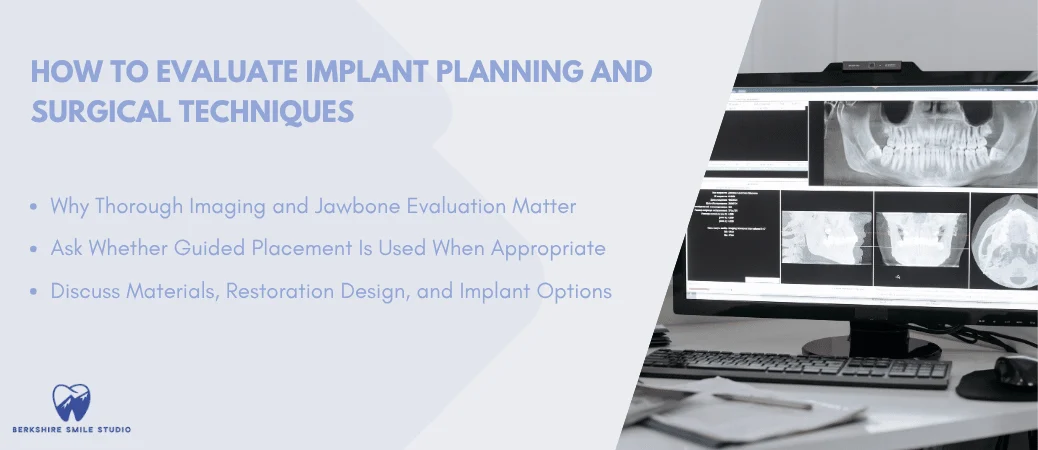
Why Thorough Imaging and Jawbone Evaluation Matter
Your dentist needs a clear picture of your jawbone before starting dental implant treatment. This is why cone beam CT scans and 3D imaging matter so much.
These tools show your jawbone density, nerve position, and sinus location in detail. Digital x-rays alone often don’t give enough information for safe planning.
A thorough presurgical evaluation checks your dental, medical, and social history too. Your dentist should also look at your gums and bite before moving forward.
Skipping these steps can lead to problems with your implant later. Ask your dentist directly what type of imaging they use and why.
Ask Whether Guided Placement Is Used When Appropriate
Computer-guided implant placement uses your 3D scans to create a custom surgical guide.
This guide fits over your teeth and shows the dentist exactly where to place the implant. It can make your implant surgery more accurate and often faster.
Not every case needs guided implant placement, but it helps in tricky spots like near nerves or thin jawbone. Ask your dentist if computer-guided surgery is part of their normal process.
A good dentist will explain when this technology is useful and when it isn’t needed. This shows they’re thinking about your safety, not just using tools for show.
Discuss Materials, Restoration Design, and Implant Options
Your final results depend on more than just the implant itself. The abutment, the piece that connects your implant to your artificial tooth, needs to fit well and match your bite.
Ask what materials your dentist uses for both the implant and the crown.
Planning should also work backward from your desired replacement teeth. This means your dentist figures out how your final tooth should look and function first, then plans the implant type, angle, and depth around that goal.
This approach helps make sure your new tooth looks natural and works properly for years to come.
Use the Consultation to Evaluate Personalized Care
Your consultation is more than a quick exam. It’s your chance to see how well a dentist listens to you, plans your care, and handles your specific health needs.
Expect a Complete Oral and Medical Health Assessment
A dental implant consultation starts with a full look at your mouth and your health history. The dentist should check your gums, teeth, and jawbone, and take x-rays or a 3D scan.
Whether planning dental implants for seniors or anyone, they should also ask about your medical history. This includes any medications you take, past surgeries, and conditions like diabetes.
This step matters because your overall health affects how well implants heal. A dentist who skips this step, or rushes through it, may not be looking out for your best interest.
Take note of how much time they spend on this part of your visit.
Review Your Personalized Treatment Plan
After the exam, the dentist should walk you through a personalized treatment plan made just for you.
This plan should explain how many implants you need, where they will go, and what type of restoration you’ll get.
Your options may include a single implant, a bridge, or full dentures.
The plan should also list the steps involved and how long each one takes. Ask the dentist to explain why they chose this plan over other options.
A good dentist will take time to answer your questions instead of giving short, vague answers.
Discuss Bone Grafting, Gum Health, and Complex Needs
Many patients need extra care before implants can be placed. Bone loss in the jaw is common, especially if you’ve been missing teeth for a while.
If this applies to you, the dentist should explain whether you need a bone graft to build up the area first.
Gum disease is another factor that can affect implant treatment. Active gum disease usually needs treatment before implant surgery can move forward safely.
Ask direct questions about your case:
- Do I have enough bone to support an implant?
- Will I need a bone graft, and how long is the healing time?
- Is my gum health good enough for surgery right now?
Gauge Communication, Comfort, and Sedation Support
Your comfort during treatment matters just as much as the technical plan. Ask what sedation options are available, especially if you feel nervous about dental work.
Common choices include local anesthesia, nitrous oxide, or IV sedation for more involved cases.
Pay attention to how the staff talks to you during the visit. Do they explain things in plain language? Do they check in on how you’re feeling?
A team that takes patient comfort seriously will make sure you understand each step and feel at ease before, during, and after your implant treatment.
Check Results, Reputation, and Long-Term Support
You want proof that a dentist gets good results, not just a nice website. Look at patient reviews, ask about success rates, and find out what happens after your surgery is done.

Read Reviews With a Balanced Eye
Patient reviews can tell you a lot, but you need to read them the right way. Look for patterns across many reviews instead of focusing on one bad comment or one perfect score.
Pay attention to what people say about pain management, office wait times, and how the staff explained things.
Patient testimonials that mention specific details, like how long healing took or how a problem was fixed, tend to be more trustworthy than short one-line reviews.
Check more than one site. Google, Yelp, and the dentist’s own website may show different sides of the same practice.
If most reviews mention high patient satisfaction with clear communication, that’s a good sign.
A few negative reviews aren’t a dealbreaker, but repeated complaints about the same issue should make you pause.
Ask About Outcomes, Success Rates, and Complication Management
Don’t be shy about asking a dentist how often their dental implants succeed and how they handle problems when they come up. A confident dentist won’t dodge this question.
Implant failure does happen, even with skilled providers, so what matters more is how the dentist responds. Ask them directly: what causes most failures in their practice, and what steps do they take to fix things?
You should also ask how they handle complex cases, like patients with low bone density or gum disease.
A good dentist will explain their process clearly, including how they screen for risks before surgery and what backup plans they have if healing doesn’t go smoothly.
This kind of transparency protects your oral health and your wallet.
Confirm Follow-Up Visits and Maintenance Expectations
Getting an implant placed is just the start. You need a clear plan for what comes next.
Ask how many follow-up visits are included and how often you’ll need checkups after that.
Some dentists build in visits at one week, one month, and six months, while others may space them differently.
Find out what aftercare instructions look like and whether they cover things like cleaning tools, diet changes, or signs of infection to watch for.
You should also ask what happens if something goes wrong months or years later.
Will they charge extra for adjustments, or is ongoing support part of the original plan? Knowing this upfront helps you avoid surprise costs and keeps your implant healthy for years to come.
Compare Costs and Make a Confident Final Decision
Cost is a big part of choosing an implant dentist, but it should never be the only thing you look at.
Getting clear numbers, understanding your financial options, and comparing a few providers will help you make a choice you feel good about.
Request a Written, Itemized Cost Estimate
Ask every implant provider for a written estimate before you agree to anything. This should break down each part of your treatment, not just show one lump number.
A good estimate lists the implant post, abutment, crown, any bone grafting, imaging, and follow-up visits separately. This makes it much easier to compare offices side by side.
Prices shift based on your location, the materials used, and how complex your case is. If a quote seems low, ask what it does and doesn’t include.
Missing steps often show up as surprise charges later.
Clarify Dental Insurance and Financing Options
Before you commit to an implant treatment plan, call your dental insurance company directly. Ask specifically what implant procedures are covered and what your annual maximum looks like.
It also helps to ask your implant provider to submit a pre-treatment estimate to your insurer.
This gives you a clearer picture of costs before surgery begins.
If insurance falls short, ask about in-house payment plans or third-party financing. Many offices offer options that spread payments over several months with little or no interest.
Avoid Choosing on Price Alone
It’s tempting to pick the cheapest option, but that can backfire with something as important as dental implant procedures.
A low price sometimes means lower-quality materials, less experience, or corners cut on imaging and planning.
Instead, ask each implant provider about their training, how many implants they place each year, and their success rate.
A dentist with strong outcomes and high patient satisfaction may charge more, but you’re paying for skill and fewer complications.
Think about the long run, too. A failed implant that needs to be redone almost always costs more than paying a fair price the first time.
Weigh price alongside experience, technology used, and how comfortable you feel with the dentist. All of these factors matter together, not separately.
Compare Consultations Before Committing

Try to schedule two or three consultations before you make a final decision. Many offices offer these visits for free or at a low cost.
During each dental implant consultation, ask the same set of questions so you can compare answers fairly. Bring up your treatment timeline, materials used, and what happens if something goes wrong after surgery.
Pay attention to how each dentist communicates. A provider who listens carefully and explains things clearly is often easier to trust with your care.
Comparing a few offices helps you spot differences in price, approach, and comfort level. It also gives you a chance to notice any red flags before you’re locked into treatment.
Frequently Asked Questions
Choosing an implant dentist involves checking credentials, comparing specialists, and asking the right questions before you commit to treatment.
Here are answers to common questions that can help you feel confident in your decision.
What qualifications should I look for in a dental implant specialist?
Look for a dentist who has completed extra training in implant dentistry beyond dental school. This can include a residency in oral surgery or periodontics, or advanced certificate programs focused on implants.
Ask how many hours of continuing education your dentist has completed in implant dentistry. You want someone who keeps learning as techniques and technology improve.
At Berkshire Smile Studio, Dr. Shakil Syed brings over 12 years of dental experience and advanced training in implant dentistry.
He completed the Maxicourse in Implantology and is a member of the American Academy of Implant Dentistry, reflecting his continued focus on implant care and modern treatment techniques.
Should I choose an oral surgeon, periodontist, or general dentist for dental implants?
All three types of dentists can place implants, but each brings something different to the table. Oral surgeons specialize in surgery and often handle complex cases involving bone grafting or extractions.
Periodontists focus on gum health and the structures that support your teeth, which makes them a strong choice if you have gum disease.
General dentists who have completed extra implant training can handle straightforward cases and may also place the crown that goes on top.
The best choice depends on your specific needs. A dentist who reviews your experience, technology, and training can help you figure out which type of specialist fits your situation.
How can I tell if an implant dentist has enough experience?
Ask how many implant procedures the dentist has performed. A dentist who places implants regularly is more likely to handle your case smoothly.
You can also ask about their success rate and how they handle complications if they come up. Don’t be afraid to ask for before-and-after photos of past patients with cases similar to yours.
Checking reviews from other patients can give you a sense of their track record too. Look for feedback specifically about implant results, not just general dental care.
What questions should I ask during a dental implant consultation?
Your consultation is the time to get clear answers about your treatment. Ask what type of implant they recommend and why, along with how many appointments the process will take.
Find out what happens if something goes wrong, such as implant failure or infection. A good dentist will explain how they monitor and manage these risks clearly and without pressure.
Other helpful questions include:
- What is included in the total cost?
- What type of anesthesia or sedation will be used?
- How long is the healing and recovery time?
- What materials will be used for the implant and crown?
How do I compare dental implant treatment plans and costs?
Get a written treatment plan from each dentist you’re considering. This should break down every step, including consultations, surgery, and follow-up visits.
Compare what’s included in the total price. Some dentists bundle in the cost of X-rays, bone grafts, or sedation, while others charge separately for each item.
Ask about payment plans or financing options if cost is a concern. Comparing at least two or three treatment plans can help you spot differences in price and approach before you decide.
What should I know before choosing a dentist for dental implants?
Take time to check credentials, ask about experience, and get a clear treatment plan before you move forward. This helps you avoid surprises and know what to expect at each step.
Pay attention to how comfortable you feel with the dentist and their team. Trust and clear communication matter just as much as technical skill when it comes to a smooth outcome.
Watch for warning signs like rushed answers or pressure to decide quickly. A dentist who takes time to explain your options is more likely to give you the care you need.